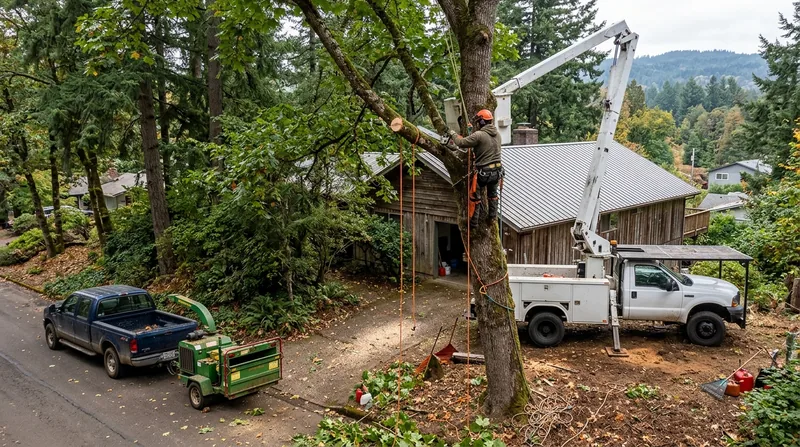




Eugene's tree-lined neighborhoods, from the Whiteaker bungalows near downtown to the South Hills split-levels tucked into steep wooded lots, depend on mature Douglas-fir, western redcedar, bigleaf maple, and Oregon white oak to frame homes and provide shade. But the Willamette Valley's wet winters, heavy clay soils, and periodic atmospheric-river windstorms put constant stress on these trees, snapping limbs, causing dieback, and creating real safety risks to roofs, power lines, and people below. That's where professional tree trimming and pruning in Eugene makes the difference: removing dead wood, thinning crowns to reduce wind load, clearing sight lines, and improving structure so your trees stay healthy and your property stays safe. Eugene Tree Service brings field expertise and experienced arborists to every job, working with your home's specific site conditions and the local species that dominate your block.
Why Tree Trimming and Pruning Matters in Eugene's Wet, Windy Climate
The Willamette Valley floor where Eugene sits receives heavy rainfall from November through March, and atmospheric-river storms regularly topple or snap trees that are already stressed by waterlogged clay soils and root rot. Mature Douglas-firs, the backbone of many older residential lots, are especially vulnerable when their root systems fail in saturated ground. Crown thinning, deadwood removal, and strategic limb clearance reduce the wind-catching surface and eliminate the weak branches that snap first in a storm, protecting your home, your neighbors' property, and the tree itself. Regular pruning also improves air circulation, which is critical in Eugene's damp climate where fungal disease, canker, and mistletoe take hold on crowded, shaded limbs.
- Remove dead, diseased, and crossing limbs that invite pest damage and fungal infection in humid conditions.
- Thin crowns to reduce wind load and improve light penetration, slowing western redcedar dieback and root rot.
- Clear sightlines to driveways, roofs, and power lines before a storm brings limbs down onto structures.
- Improve tree structure so young or multi-stemmed trees grow strong and don't split under ice or wet snow load.
- Address English ivy and Himalayan blackberry climbing old trunks, which trap moisture and accelerate decay.
Proactive trimming and pruning in Eugene is not cosmetic, it is survival strategy in a climate where winter storms and waterlogged soil are the rule, not the exception.
Key info: Many Eugene neighborhoods sit on clay-heavy lots that stay saturated all winter. A Douglas-fir or western redcedar that looks healthy in July may be rotting at the root by February. Crown thinning removes weight and wind resistance, and deadwood removal eliminates the visible sign that disease is already present. Early intervention prevents emergency removal later.
For more details on how weather and soil conditions affect your trees, visit the arborist consultation page to schedule a site-specific assessment.
Oregon's Department of Forestry provides guidance on tree health and storm resilience: Oregon Department of Forestry Resources.
How We Approach Tree Trimming and Pruning in Eugene
Our experienced arborists start with a walk-around assessment of your trees, the structures nearby, the soil conditions, and the local species. We identify dead wood, disease, structural weakness, and hazardous limbs, then propose a pruning plan that improves health and safety without over-cutting or leaving stubs that won't heal. We work year-round in Eugene, timing dormant-season work in late fall and winter to reduce stress on trees and minimize sap flow, and summer work only when necessary for safety or disease management. All work follows standard arboricultural practice, with clean cuts, no topping, and respect for the tree's natural form and ability to compartmentalize wounds.
- We assess the tree species, age, health, and site conditions, including soil saturation and proximity to structures.
- We identify dead, diseased, crossing, and low-hanging limbs that pose safety or health risks.
- We propose a pruning strategy: crown thinning, deadwood removal, clearance trimming, or structural pruning depending on the tree's needs.
- We execute the work with sharp tools, proper climbing or bucket-truck access, and chip or haul all debris same-day.
- We leave the tree with a clean crown, good structure, and the ability to compartmentalize wounds and grow strong.
From a Craftsman bungalow in Fairmount with a 70-year-old bigleaf maple shading the porch, to a River Road ranch home where a Douglas-fir is dropping dead branches near the roof, we tailor the work to your tree and your home.
Local example: A South Hills split-level with a multi-stemmed Douglas-fir on a steep lot had one stem showing canker and the crown was so dense that rain never dried. We removed the diseased stem, thinned the crown by 25 percent, and cleared the lower limbs so the homeowner could see the driveway. The tree recovered, the house is safer, and the owner avoided a costly removal.
If your tree needs more than pruning, we also offer tree removal and stump grinding for trees that are beyond saving.
Tree Trimming and Pruning Methods
| Approach | Description | Best for |
|---|---|---|
| Deadwood Removal | Remove all dead, diseased, or dying limbs back to live branch collar or the branch bark ridge. | Trees showing canker, mistletoe, or dieback; urgent safety hazards from hanging dead limbs. |
| Crown Thinning | Selective removal of interior and crossing limbs to reduce crown density by 15 to 25 percent, improving light and air flow. | Mature trees in wet climate; reducing wind load before storm season; improving health in dense, shaded crowns. |
| Crown Raising | Remove lower limbs to clear sightlines, improve pedestrian or vehicle clearance, and improve structure. | Limbs over roofs, driveways, or power lines; opening views; allowing mowing or access beneath the tree. |
| Structural Pruning | Remove co-dominant stems, crossing limbs, and weak branch angles to establish a single strong leader and sound architecture. | Young trees or multi-stemmed trees that need training; preventing future splits or failure under ice or wind. |
| Clearance Trimming | Remove limbs to a safe distance from structures, utilities, or property lines without compromising tree health. | Limbs touching or overhanging roofs, gutters, antennas; branches near power lines; neighbor disputes. |
Tree Trimming and Pruning Cost in Eugene: What to Expect
Tree trimming and pruning costs in Eugene start at $250 to $400 for a small tree or modest crown thinning, and scale up based on tree size, species, access, proximity to structures, and the scope of work. A 40-foot Douglas-fir requiring full deadwood removal and crown thinning typically runs $600 to $1,200 depending on limb density and how much climbing or bucket-truck work is needed. Trees growing near roofs, power lines, or over multiple structures cost more because the work demands greater precision and safety precautions. If your tree is heavily diseased, multi-stemmed, or located on a steep South Hills lot with difficult access, the cost moves up again. The best way to know your actual price is to request a free estimate, which includes a site walk and a clear, itemized quote.
Getting two or three estimates from insured contractors is smart practice. You'll see how different arborists assess the same tree, and you'll avoid low-ball quotes that leave stubs, over-cut crowns, or incomplete debris removal. Our estimates are free, response within 24 hours, and there is no obligation to book.
For detailed pricing on different service types and job scales, visit our full pricing page.
Tree Trimming and Pruning Near Me: What Eugene Homeowners Should Know Before Hiring
When you're looking for tree trimming and pruning near Eugene, start by confirming that the contractor is insured, and experienced with the specific species on your property. A experienced arborist will know how Douglas-fir, western redcedar, bigleaf maple, and Oregon white oak respond to pruning in Eugene's wet climate, and they'll understand the soil and storm risks that affect your neighborhood. Check references from recent Eugene jobs, ask whether they have liability and workers compensation insurance, and request a copy of their license. If your tree is large, old, or near structures, a site visit and written estimate are non-negotiable.
Be aware that some Eugene neighborhoods, especially near downtown and the University district, have heritage tree ordinances that protect oak, redwood, and other species above a certain size. The City of Eugene requires permits for tree removal and sometimes for major pruning on protected trees. Your contractor should know these rules and help you navigate the process if needed. If you live in an HOA community, check your covenants before starting work on visible trees. And if a neighbor's limb is overhanging your property, Oregon law allows you to trim back to the property line, but not to climb onto their land or damage the tree, so getting professional guidance prevents disputes.
- Verify the contractor holds current business license and liability insurance covering tree work in Eugene.
- Ask for references from recent tree trimming or pruning jobs in your neighborhood or similar residential setting.
- Request a written estimate that specifies which limbs will be removed, the method (thinning, deadwood, raising), and the total cost.
- Check with the City of Eugene if your tree is protected or if permits are required for the work you're planning.
- Review your HOA rules and covenants if applicable, and confirm that visible pruning won't trigger an approval requirement.
- Discuss storm season timing if your tree is at risk, and ask whether the contractor offers emergency tree service if a limb fails.
Hiring a professional who understands Eugene's climate, soil, species, and local regulations protects your investment in your property and ensures your trees stay healthy for decades to come.
Ready to get started? Contact Eugene Tree Service for a free, no-obligation estimate. Call (541) 214-2196 or fill out our online form and we'll respond within 24 hours.
Tree Trimming & Pruning in Eugene: Pricing Guide
| Service | Price | Details |
|---|---|---|
| Small tree or modest crown work | Starting at $250 | Deadwood removal or light thinning on trees up to 30 feet tall with good access and simple structure |
| Medium tree, full service | $600 to $1,200 | 40-foot Douglas-fir or cedar requiring deadwood removal, crown thinning, and clearance trimming on residential lot |
| Large tree or complex site | $1,200 to $2,500 | Mature trees near structures, power lines, steep terrain, or requiring bucket truck and advanced rigging for safety |
| Multiple trees or land clearing | On estimate | Pricing depends on tree count, species, size, site access, and whether removal or stump grinding is included |
| Travel | Included | No separate mileage or call-out fee within Eugene and surrounding service area communities |
| Free estimate | No charge | Site walk and written quote within 24 hours, no obligation to proceed with booking or payment |
Indicative pricing, the exact cost depends on square footage, finish, and site access. Free personalized estimate within 24h at (541) 214-2196.


