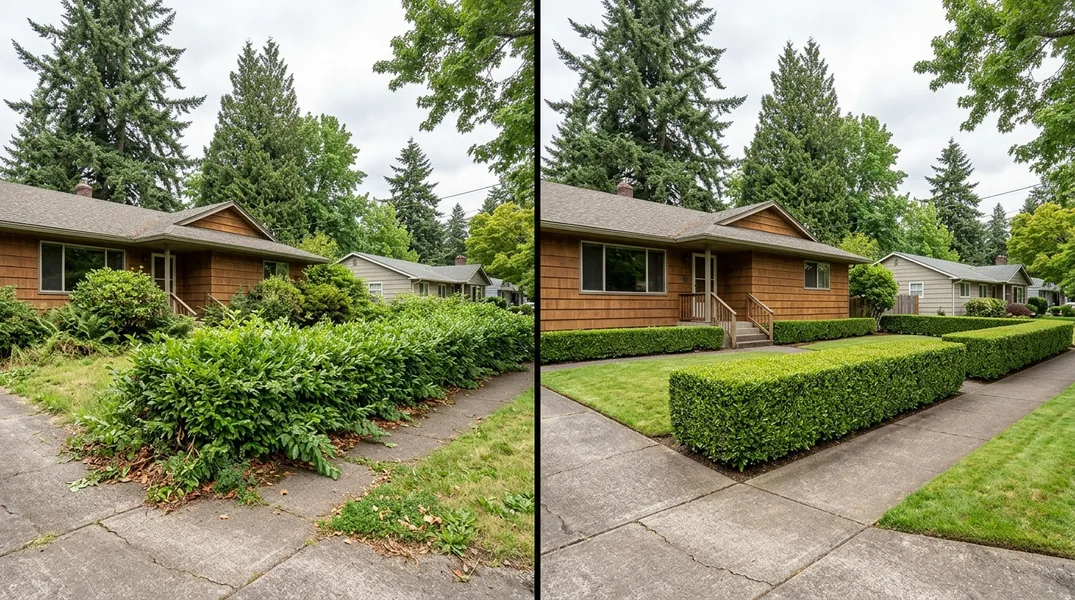
Understanding the Difference: Tree Trimming vs. Removal
When you notice a Douglas-fir or other tree on your property showing signs of stress, disease, or overgrowth, the first question that comes to mind is often simple: does it need to come down, or can it be saved? The answer depends on several factors that a trained arborist evaluates during a Eugene property assessment. Tree Trimming & Pruning is a preventive and restorative practice that removes dead, diseased, or overgrown branches to improve the tree's health, appearance, and safety. Tree Removal, by contrast, is the complete extraction of a tree from the ground, typically reserved for situations where the tree poses a genuine hazard or is beyond recovery.
Many homeowners assume that a tree showing problems must be removed entirely. In reality, most trees can be preserved through strategic pruning and ongoing care. Tree Trimming & Pruning not only extends the life of your trees but also reduces the cost and disruption associated with removal and subsequent Stump Grinding. Understanding the difference between these two approaches empowers you to make the right decision for your property's landscape and your family's safety.
Signs Your Douglas-Fir Can Be Saved with Proper Pruning
Douglas-firs are iconic to the Pacific Northwest and are generally resilient trees when given proper care. If your tree is displaying early warning signs such as some dead branches, minor disease symptoms, or crowding with neighboring vegetation, pruning is often the ideal first step. A healthy Douglas-fir with active growth in most of its canopy, even if it has a few problem areas, is typically a candidate for Tree Trimming & Pruning rather than removal. Professional arborists look for signs of vigor: new shoots, green foliage throughout much of the crown, and structural integrity in the main trunk and primary branches.
Common issues that respond well to pruning include crossing or rubbing branches, deadwood that accumulates over time, branches growing into power lines or structures, and minor fungal infections confined to specific limbs. Removing these problem areas not only improves the tree's appearance but also enhances air circulation within the canopy, reduces the weight load on weakened sections, and allows the tree to redirect energy toward healthy growth. In many cases, a single strategic pruning session can transform a struggling tree into a thriving one, provided the underlying health of the tree is sound.
When Removal Becomes Necessary: Hazard Tree Assessment in Eugene
Not every tree can or should be saved. A professional hazard tree assessment is essential for determining when Tree Removal is the safer and more responsible choice. Trees that have suffered severe storm damage, are infested with destructive pests, or are afflicted with terminal diseases may have little chance of recovery. Similarly, a tree with significant structural defects such as deep cavities, severe lean, or major trunk damage poses an ongoing risk to nearby structures, utility lines, and people on the property.
In Eugene, where winter storms and heavy rainfall are common, hazard assessment is particularly important. A tree that has lost more than 50 percent of its crown, has multiple large dead branches, or shows signs of root failure may be too compromised to justify the cost of ongoing pruning and care. Additionally, if a tree is growing too close to your home, garage, or power lines and cannot be safely pruned to an acceptable distance, removal may be the only practical solution. An arborist will evaluate the tree's location, size, condition, and proximity to valuable assets before recommending a course of action.
The Cost Difference: Tree Trimming vs. Removal in Eugene
One of the most practical considerations for homeowners is the financial impact of each option. Tree Trimming & Pruning is generally far less expensive than complete removal, typically ranging from a few hundred dollars for routine maintenance on smaller trees to a couple of thousand dollars for extensive work on large specimens. Pruning also requires no follow-up work such as stump removal or site restoration, making it a straightforward investment in your tree's long-term health.
Tree Removal and Stump Grinding represent a significantly larger financial commitment, especially for mature Douglas-firs that can be 60 feet tall or more. The complexity of the removal, proximity to structures, and local regulations in Eugene all influence the final cost. However, if a tree is genuinely hazardous or diseased beyond recovery, the cost of removal is an investment in safety and peace of mind. For a detailed understanding of what your specific situation will cost, Eugene Tree Service recommends requesting a free estimate from a experienced arborist who can assess your tree in person and provide accurate pricing based on its condition and location.
How Professional Arborists Decide: The Assessment Process
When you call Eugene Tree Service at (541) 214-2196 for a consultation, a experienced arborist will conduct a thorough evaluation of your tree using industry-standard criteria. This assessment includes examining the trunk for cracks, cavities, or signs of decay, checking the canopy for the percentage of living branches versus deadwood, evaluating branch attachment angles, and looking for evidence of pest infestation or disease. The arborist will also consider the tree's species, age, location, and your goals for your landscape.
The decision to prune or remove is rarely black and white. An experienced arborist weighs factors such as the tree's potential for recovery, the cost-benefit analysis of treatment versus removal, safety considerations, and your preferences as a property owner. Many trees that initially appear to be candidates for removal can actually be preserved through a combination of strategic pruning, disease management, and ongoing monitoring. Conversely, some trees that seem salvageable may pose too great a risk to justify the investment in care. This nuanced evaluation is why professional assessment is so valuable and why attempting to make this decision without expert input can lead to costly mistakes.
Taking Action: When to Call Eugene Tree Service
If you have a Douglas-fir or other tree in your yard that concerns you, the best course of action is to reach out for professional guidance. Whether your tree needs pruning to restore its health and appearance, a hazard assessment to determine its safety status, or removal to eliminate a genuine risk, Eugene Tree Service has the expertise and equipment to help. The sooner you address tree health issues, the more options you typically have available.
Contact Eugene Tree Service today at (541) 214-2196 or visit our website to request a free estimate. Our experienced arborists will evaluate your tree, explain your options in clear language, and recommend the best course of action based on your tree's condition and your property's needs. Whether your tree can be saved with thoughtful pruning or needs to be removed for safety, we are here to help you make the right decision and execute it professionally.
Looking for a professional tree service contractor in Eugene? Eugene Tree Service responds fast for all your tree service needs.
Get a Free QuoteOur services: Tree Removal · Tree Trimming & Pruning · Stump Grinding